After 25 years of navigating the Linux ecosystem, I’ve developed a very specific set of requirements for my daily driver. For the last decade, Gnome was my undisputed choice. Coming from a background where I never quite clicked with KDE, Gnome provided the professional environment I required as a web designer.
My workflow is demanding. I’m constantly cycling through SFTP connections, managing bulk asset renames, and purging hundreds of images fast. One of my non-negotiables was the ability to turn off the internet while retaining local LAN connectivity—a necessity for certain offline development tasks—and Gnome handled this beautifully.
The Breaking Point
But by 2025, something changed. Or rather, Gnome did.
I reached a breaking point where the latency became unacceptable. In my world, when I hit Ctrl + T, I expect the terminal to be there instantly. Waiting two seconds for a terminal to load, and another second for it to actually be ready for input, is a friction I can no longer ignore. It wasn’t just the terminal; the general “heaviness” had seeped into all my most-used applications.
So, I decided to go back to XFCE.
Efficiency Without Compromise
For some, XFCE is “too simple.” For me, simple is exactly what the doctor ordered. I found that I didn’t lose a single piece of the functionality that made me love Gnome, but I gained back my speed. I discovered that the same network agility I relied on in Gnome—specifically the ability to toggle routes to disable the internet while staying on the LAN—is just as accessible here.
The responsiveness is where the real win is. Thunar, xfce4-terminal, and the image viewer now snap open instantly. I’ve grown to really appreciate Thunar as a file manager; it’s lean, but it’s powerful enough that I can easily connect to my Mac and move files back and forth without any friction.
If you’ve ever spent time in ComfyUI or Forge WebUI, you know the pain of generating 50 images only to keep one. I need to be able to delete the other 49 immediately. (Trying to do that volume of rapid-fire quick preview > deletion on a Mac is a recipe for insanity; I’ll leave it at that).
Aesthetics and Ergonomics
Beyond the core apps, I’ve found that XFCE is a canvas for those who care about aesthetics. I don’t believe a “lightweight” DE has to look like it’s from 1995. By spending ten minutes applying a dark wallpaper, the Mac-Tahoe-Dark theme, and the accompanying icons, I’ve achieved a polished look that rivals macOS.
Because I work on an ultrawide monitor, I’ve configured my dock to be roughly 600px and centered it at the bottom. This drastically reduces mouse travel; I no longer have to drag my cursor across a massive screen to the bottom-left corner just to launch an app.
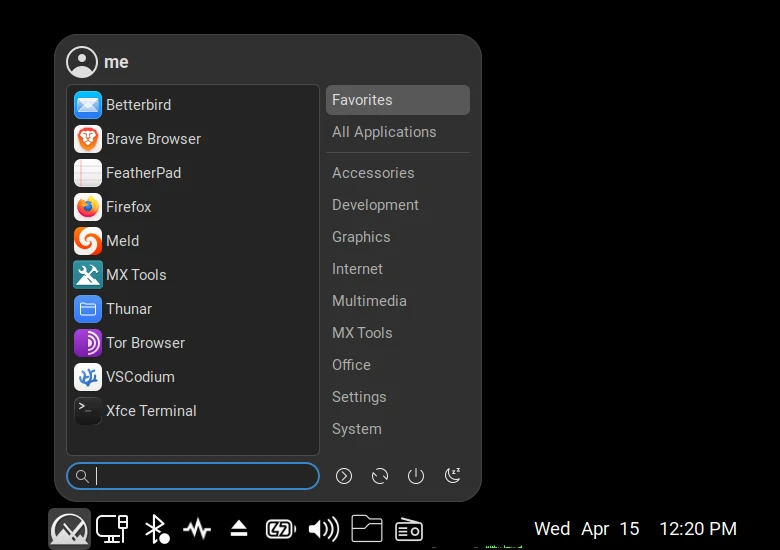
To get the Wed Apr 15 12:20 to display, I opened the clock preferences > clock options and used: %a %b %d %I:%M %p. I also bumped the font size to 14.
If you’re curious about other tweaks I’ve made, simply leave a comment.
The Power User’s Advantage
The “underrated nugget” for me, however, is the XFCE Settings. I find the centralization of tweaks to be pure genius. Once I have my panel and Whisker Menu configured exactly how I like them, I take an MX Linux snapshot to bake those settings into my system permanently.
From a technical standpoint, XFCE exposes the right settings in the right places. Whether I’m setting a static IP or editing routing and gateways for dual-NIC configurations, the process is straightforward and transparent.
I’m fortunate to have high-end hardware that could run any desktop environment on the market. But hardware doesn’t matter if the software feels sluggish. Until Gnome can match the raw, instantaneous speed of XFCE, this is where I’ll be staying. Bypassing a lightweight environment in favor of “modern” bells and whistles often comes with a hidden tax of frustration and wasted time—a tax I’m no longer willing to pay.